

 By
By For anyone venturing off the beaten path, navigation is one skill that’s truly indispensable. Whether you’re hiking, exploring the wilderness, or participating in an orienteering race, knowing how to read maps and use a compass can make all the difference. In this post, I’m sharing what I’ve learned from Matt Boger, a retired Army Ranger and expert navigation instructor at The Survival University. While I’m no pro myself, Matt’s lessons have made navigating the great outdoors—and even urban environments—much more intuitive. Let’s dive in and explore how you can master the art of navigation, whether you’re a beginner or looking to sharpen your skills.
What Is Navigation?
In simple terms, navigation is the process of finding your way from point A to point B, especially when modern tech like GPS isn’t available. It’s all about reading the land, using tools like maps and compasses, and figuring out the best route to your destination. While orienteering might sound similar, it’s a bit more specialized—think of it as navigation turned into a race against the clock. However, navigation is the broader skillset that supports both recreational adventurers and those who need it in emergencies.
When I first started learning about navigation, I thought it was something only seasoned explorers or military professionals needed. But as I gained experience, I realized it’s a skill anyone can benefit from. Whether you’re out hiking, trying to find your way home, or simply getting lost in the wilderness, navigation gives you the freedom and confidence to explore safely.
Why Navigation Is Still Relevant Today
With technology constantly evolving, it’s easy to think that traditional navigation tools are outdated. After all, we all have smartphones with GPS, right? Well, the truth is, technology fails. Batteries die, signals get lost, and phones break at the worst possible moments. When these things happen, navigation with a map and compass is your backup. It’s also an invaluable skill in an emergency. Imagine you’re lost in the woods and your phone dies—being able to read a map and use a compass could make the difference between finding your way home and getting further off track.
Even if you’re not an extreme survivalist, navigation is a great skill to have. Whether you’re hiking off-trail, hunting in remote areas, or racing in orienteering events, mastering navigation opens up countless adventures. At The Survival University, Matt’s expertise has trained everyone from beginners to military personnel in the fine art of navigating, and there’s something empowering about truly understanding your surroundings.
Essential Navigation Tools: Maps, Compasses, and More
At its core, navigation is about using the right tools and understanding how to apply them. Let’s break down the key equipment you’ll need to start your journey.
Topographic Maps: Your 3D View of the Terrain
Topographic maps, or “topo maps,” are a step up from regular road maps. They provide detailed information about the land’s features, like hills, valleys, rivers, and more. The magic is in the contour lines. These lines show elevation changes—closely spaced lines represent steep slopes, while wide-spaced lines indicate gentle hills. It’s like seeing the land in three dimensions.
Topo maps also use grid systems like UTM (Universal Transverse Mercator), which divides the earth into squares. These grids let you pinpoint your exact location with coordinates, much like a treasure map. Once you get familiar with how to read them, topo maps become a powerful tool for planning your route.
The Compass: Your Trusty Guide
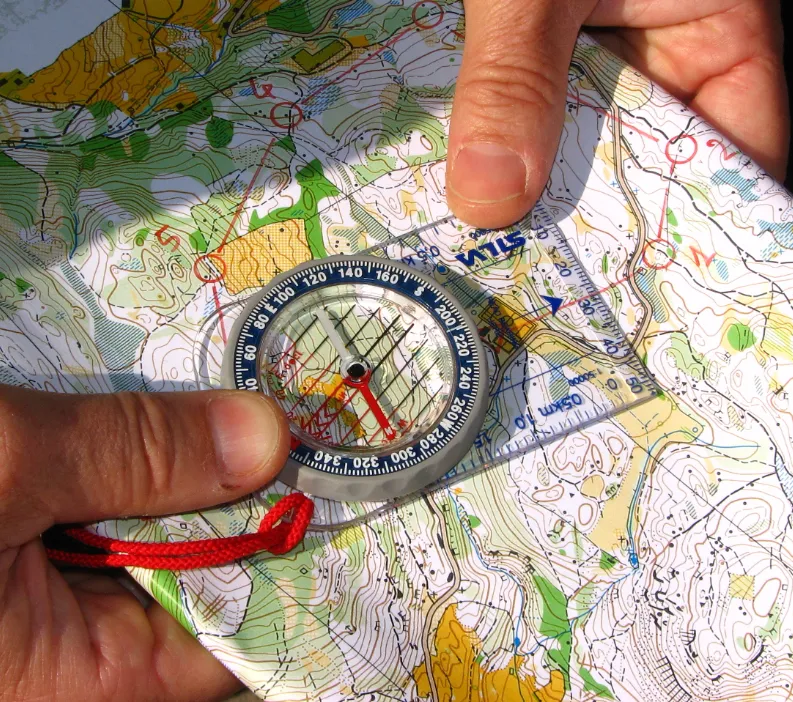
A compass is essential for any navigation task. While it seems simple, it’s actually a highly precise tool. A quality compass, like the ones we use in our courses, has several key components:
- Baseplate: The flat section that sits on your map.
- Rotating Bezel: The outer ring with degrees (0-360) that helps you set a direction.
- Magnetic Needle: Points to magnetic north.
- Orienting Arrow: Used to align your compass with your map.
- Direction of Travel Arrow: Points to where you want to go.
For more serious navigation, a lensatic compass is ideal. It’s durable, easy to read, and even includes features for advanced sighting. Whether you’re just starting out or competing in orienteering, a compass is your go-to guide for staying on course.
Azimuth and Declination: Understanding Direction
To navigate accurately, it’s essential to understand azimuths and declination. An azimuth is simply the direction you want to go, measured in degrees from north. For example, north is 0°, east is 90°, south is 180°, and west is 270°. Using your compass, you can take an azimuth and follow it precisely.
Declination is a trickier concept. Magnetic north (where your compass needle points) doesn’t align perfectly with true north (the top of your map). The difference between these two is called declination, and it can range from a few degrees to more than 20°, depending on where you are. Ignoring declination can lead you far off course, so it’s important to account for it when setting your azimuth.
Putting It All Together: How to Navigate in the Wild
Let’s break down a practical navigation scenario: say you want to hike to a lake three miles away. Here’s how you would approach it:
- Orient Your Map: Lay your map flat, place your compass on it, and rotate it until the compass needle points to true north on the map.
- Identify Your Location: Use landmarks like hills, rivers, or trails to find your starting point on the map.
- Plot Your Course: Draw a line from your location to the lake, then measure the azimuth using your compass (let’s say it’s 120°).
- Account for Declination: If the declination in your area is 10° east, subtract that from your azimuth (120° – 10° = 110°).
- Set Your Direction: Set your compass to 110°, align the direction of travel arrow with the terrain, and start your hike. Keep checking your map and compass to ensure you’re on track.
It sounds complex, but once you practice, it becomes second nature. Try this in a local park or even in your backyard to build confidence. Before long, you’ll feel like a seasoned navigator.
The Fun of Orienteering
If you want to take your navigation skills to the next level, try orienteering. It’s a sport that challenges you to navigate a course using a topo map, moving between control points in a set order. It’s a mix of physical endurance and mental strategy, and it’s an excellent way to improve your map-reading skills under pressure. Orienteering courses can range from beginner-friendly sprints to multi-day challenges, so there’s something for everyone.
Racing in orienteering events can be thrilling, and they give you a perfect opportunity to practice the navigation techniques you’ve learned. Whether you’re new to the sport or an experienced competitor, orienteering will sharpen your navigation abilities and make you more confident in the wild.
Conclusion: The Adventure of Navigation
Navigation is more than just a survival skill; it’s an adventure in itself. From learning to read maps and compasses to applying them in real-world scenarios, every step you take brings you closer to mastering the landscape around you. The thrill of finding your way without technology is unmatched, and once you’ve got it down, you’ll feel a sense of freedom that’s hard to beat.
Whether you’re hiking in the woods, participating in orienteering, or just enjoying a weekend adventure, navigation skills will make your journeys safer and more enjoyable. At The Survival University, we teach all the fundamentals, and with expert instructors like Matt Boger, you’ll be navigating like a pro in no time. Ready to start your journey?